Lately, Kashmala has been asking me “why” every time I tell her something, even if it’s not about not doing something. She once asked me why people cry. And I gave an answer and she said, “Why?” And the “Why” went on and on and on and on … till she was distracted by something else.
Wednesday, May 30, 2012
The DOs and DON'Ts of Raising Kids
I'm not a mother and I'm no expert on raising kids. But I’ve learned lotsa important things from raising Kashmala (she lives with me and my family) and, before her, her brother. (I have another nephew as well, who’s now 1.5,
but I rarely get to see him, unfortunately.) Below are some of the things I’ve learned
about children (e.g., things to do in front of kids, things not to do, etc.) from
my own experiences, from a Psychology class I took a long time ago, from movies/books/tv
shows (like Law & Order – SVU), and from the Internet. Many of us already
know that kids are very observant, but we still tend to forget that they pick
up things quite fast. Experimenting is normal for them, and so it’s not uncommon
for a child to do something just to see what it will result in. In such
moments, we tend to yell at them and/or punish them, make them realize that it’s
wrong – but we don’t do the more important thing: explain WHY it’s wrong.
Lately, Kashmala has been asking me “why” every time I tell her something, even if it’s not about not doing something. She once asked me why people cry. And I gave an answer and she said, “Why?” And the “Why” went on and on and on and on … till she was distracted by something else.
Lately, Kashmala has been asking me “why” every time I tell her something, even if it’s not about not doing something. She once asked me why people cry. And I gave an answer and she said, “Why?” And the “Why” went on and on and on and on … till she was distracted by something else.

Tuesday, May 22, 2012
My Interest in Islamic Studies - Part I: the beginning
Ever since I entered Islamic Studies, I have been having the hardest time with Muslims ever. And no one seems to understand completely--because they are not in my exact situation, because every Muslim who is pursuing Islamic Studies in the West has different experiences with it, because everyone practices and understands Islam differently,
because everyone’s families are different, because everyone deals with the same situations
differently. And few really understand what "Islamic Studies" means (I myself am still exploring this, so that's not to imply that I know and no one else knows), and there are many, many misconceptions about the field, as is the case with many other fields. I have therefore decided to discuss the matter here on my blog in an effort to dispel some of the misunderstandings and to initiate a dialogue with those who cannot understand why a Pashtun Muslim female would be interested in Islamic Studies and strive to pursue it in the U.S.-- or anywhere in the West.
I thank you in advance for your readership! Please feel free to post any questions and express any feelings about it, even after I have finished with the series (a series of about three blog posts or so); you may pose your questions/comments anonymously if you'd feel more comfortable doing that.
This first blog post will be on how I got started. Part II will be on why I have decided to pursue Islamic Studies in the U.S. and not in any Muslim country like Pakistan, Egypt, Saudi Arabia, etc. Although I do intend to study certain Islamic Studies courses in traditional Islamic institutions as well (e.g., Al-Azhar in Egypt or the Islamic University of Medina in Saudi Arabia), I have learned that a traditionally Islamic institution will not be the better option for me (again, to be explained in the next post). In Part III, I will discuss the consequences of my entering Islamic Studies, how my family/relatives/friends and many other Muslims have reacted to my decision, and how I continue to struggle with it as I explain to others what exactly I am doing and why and how either they simply refuse to understand or I am unable to explain it clearly. You see, when people ask me what I am studying and I tell them I'm doing Islamic Studies and Gender Studies, they ask why I would want to pursue Islamic Studies in the west (and many often even dare to claim to "know" my intentions). In the third post, then, I will share with my readers the struggles and consequences I continue to face, especially from Muslims who, even after I explain to them what I'm doing and why, don't seem to tire from asking, rather unpleasantly, "But why in America? Why not in Saudi Arabia?" or "What - you don't think Zakir Naik is the most brilliant, most knowledgeable Islamic scholar of our time????? You must not be studying the correct Islam, that's why." Or "WHAT?!! You mean you don't believe Shi's are not Muslims??? What kind of Islam are they teaching you?" And, my favorite one: "Are your teachers Muslims? ... Hey, do your female teachers wear hijab [cover their heads]?"
Yeah, that kinda stuff.
To put it very simply, I was aware of the consequences of my decision to pursue Islamic Studies when I decided to go for it in the beginning, but I was honestly not prepared for what it has come to: it's simply too difficult to understand myself let alone to explain to anyone else. I entered the field hoping to liberate myself intellectually and spiritually, but instead, I seem to have smothered myself.
Now, let us proceed.
Monday, May 21, 2012
Things to Do Before I Turn 30
So, a very common blog post is the list of things to do before one turns 30/40/50/etc. I'm about 5 years away from turning 30, inshaAllah, so I figured I should write a list of things I'd like to have done by the time I'm 30. If they don't happen, no worries - I'll do them later on, ka khairee. But hopefully, they'll all get done! Some of these things may seem very small and silly to many people, but that doesn't bother me. They're all important to me.
I'll add to the list as I remember more. Oh, and I decided not to number them so as not to overwhelm myself - haaa haaaaa.
They’re in no particular order. Just the order in which they came to my mind.
I'll add to the list as I remember more. Oh, and I decided not to number them so as not to overwhelm myself - haaa haaaaa.
They’re in no particular order. Just the order in which they came to my mind.
Monday, May 14, 2012
Regretted. Tortured. Empowered.
In my Sociology of Sex and Gender class in summer 2009, my teacher asked us to share some of the discriminations we have encountered as women, men, both, or neither. Although I was the second person to go, I asked if I could go last to see what the other students had to say or how they defined and experienced discrimination in 21st century America. As I listened to stories about males preferring “feminine” movies or cars to masculine ones and being judged for their preference and about females being considered “bitchy” for wanting to be leaders, and other similar stories, I was reminded of the burdens that the Pukhtun woman brings to her Pukhtun family and to her Pakistani/Pashtun society as a female. Consider the following.
Thursday, May 10, 2012
A List of Haraam Things
The Haraam List
Update (October 27, 2014):
Dear readers, as of late October 2014, I've migrated to Wordpress and have slowly been moving some of my personal favorite posts there as well during the last couple of days. You can read this list of haraam things on the new blog by clicking here: The Haraam List.
Thanks!
Update (October 27, 2014):
Dear readers, as of late October 2014, I've migrated to Wordpress and have slowly been moving some of my personal favorite posts there as well during the last couple of days. You can read this list of haraam things on the new blog by clicking here: The Haraam List.
Thanks!
Tuesday, May 8, 2012
Kashmala singing and telling spooky stories
Nothing -- and I mean nothing -- calms me down better than The Kashmala! Who cares about the stress that comes with school when I have her to look forward to seeing in a couple of days! Peace! Love! Happiness! Delight!
Enjoy :)
Enjoy :)
Sunday, April 29, 2012
Pukhtun Men, Double Standards, and Respect for Pukhtun Women
Pre-post: To all those who will now start saying, "Stop generalizing": I don't expect you to get this. Besides, does saying "You're generalizing" solve the problem? If not, what's your point? Stop denying this happens because you see it on your FB feed every time you log in and you see it on Youtube videos (girls' photos as background pictures to audio music), and you (most of us) just watch, maybe read the disgusting comments about the girls' looks/bodies, and our job is done. Speak against it. Also, saying, "There ARE exceptions, you know; not all Pukhtun men do this" acknowledges that they're only exceptions--not the norm; it acknowledges that the majority with access to these pics/Internet actually do this, but there's a small minority that sincerely respects women. I'm not talking about the ones who don't do this, obviously. I'm talking about the ones who do.
_______
Double standards exist everywhere, I know, but I've seen an unbearable amount with Pukhtuns (because, silly, silly me! I expect them to be so much better than all other people in the world!). And, yes, I know the following happens in other racial groups too, but I'm "singling out" Pukhtuns because, in case it's not obvious already, I'm a Pukhtun myself. I see no logic in taking on all of the world's issues and talking about every single problem of every single nation. You do that yourself.
Here's the deal, ok?
A few days ago on one of my FB accounts (I have two), this Pukhtun guy messaged me and said "hi, how are you?" I replied a couple of days later (deliberately) and said I was well, thank you. He replies instantly and says, "What is your name? Where do you live? Are you studying or are you married?" (lol :D like I can't do both!) I replied a couple of days later with, "Hm... too many questions at once. Why don't you visit my blog and have alllll of your questions about me answered, bro?" He replied, again instantly (freaky, I know, right?), with something fobby, like "Will you be my friend?" And I replied with:
_______
Double standards exist everywhere, I know, but I've seen an unbearable amount with Pukhtuns (because, silly, silly me! I expect them to be so much better than all other people in the world!). And, yes, I know the following happens in other racial groups too, but I'm "singling out" Pukhtuns because, in case it's not obvious already, I'm a Pukhtun myself. I see no logic in taking on all of the world's issues and talking about every single problem of every single nation. You do that yourself.
Here's the deal, ok?
A few days ago on one of my FB accounts (I have two), this Pukhtun guy messaged me and said "hi, how are you?" I replied a couple of days later (deliberately) and said I was well, thank you. He replies instantly and says, "What is your name? Where do you live? Are you studying or are you married?" (lol :D like I can't do both!) I replied a couple of days later with, "Hm... too many questions at once. Why don't you visit my blog and have alllll of your questions about me answered, bro?" He replied, again instantly (freaky, I know, right?), with something fobby, like "Will you be my friend?" And I replied with:
Thursday, April 26, 2012
A Christian Wedding in Karak, Jordan
When I was in Jordan last year, one of our speaking partners (i.e., someone we had to have a discussion with about a given topic in Arabic daily for 30 minutes) invited us to his brother's wedding in Karak, Jordan, not too close to Amman where we were staying. It was really moving to hear a non-Islamic scripture recited in Arabic so beautifully. I recorded almost the whole thing, but I think what I've chosen to post publicly should suffice as an overview of what one particular Christian wedding in one particular Arab country looks like. Overall, I thought it was great! Enjoy!
By the way, I have deliberately blurred out the last part for privacy purposes. The first part takes place outside the Church in a vast courtyard, and the second part takes place inside the Church.
By the way, I have deliberately blurred out the last part for privacy purposes. The first part takes place outside the Church in a vast courtyard, and the second part takes place inside the Church.
Monday, April 23, 2012
My Response to Mona Eltahawy's "Why Do They Hate Us?"
Today, Facebook informed me that over 15 of my friends had shared Mona Eltahawy's article "Why Do They Hate Us?" on their pages. For some strange reason I can't figure out, I wasn't expecting the "they" in the title to be who it turned out to be. Like most of her articles, I read it and sighed afterwards. (I have found some of her pieces very important and worth reading -- this just wasn't one of them.) Here's my response.
Please note: This is not a coherent, organized, well-written response to the article. Instead, it's the copy-paste of some of my comments on FB.
Please note: This is not a coherent, organized, well-written response to the article. Instead, it's the copy-paste of some of my comments on FB.
Sunday, April 22, 2012
The Mispronunciation of Foreign Names: On Arabic, Muslim, and Islamic names
I don’t understand why we bless our children with names that aren’t pronounceable in our spoken languages. For example, the name/word Samina means "fat" (feminine) in Arabic; yet, it’s a common name especially in South Asian countries. Because no South Asian language, as far as I know, pronounces thaa (ﺙ) in spoken language (even if it exists in formal/written language), we spell it with the letter seen (س) instead. The actual Arabic name starts with a ,ﺙ and “Thamina” means precious, valuable.
So, when pronouncing certain letters is not common or easy in your native language, why should you have to adopt the letters of other languages (even if they have officially become a part of the formal dialect of your language), just so you can pronounce foreign words "correctly"? For instance, there’s no F (ف) in Pashto [I’ve no idea where the Pashtun tribe “Afridi” gets its name from and how! Is it supposed to be “Apridi”?] and no thaa/they (ﺙ), just like there’s no qaaf (ق) in English. So if the positive meaning of a good name is going to be distorted if the name is not pronounced properly (as with Thamina/Samina), then why even take the name? Why not keep a name original to your language, one that can be pronounced properly and not be distorted – and has a good meaning? I'm sure people have their reasons, though.
So, when pronouncing certain letters is not common or easy in your native language, why should you have to adopt the letters of other languages (even if they have officially become a part of the formal dialect of your language), just so you can pronounce foreign words "correctly"? For instance, there’s no F (ف) in Pashto [I’ve no idea where the Pashtun tribe “Afridi” gets its name from and how! Is it supposed to be “Apridi”?] and no thaa/they (ﺙ), just like there’s no qaaf (ق) in English. So if the positive meaning of a good name is going to be distorted if the name is not pronounced properly (as with Thamina/Samina), then why even take the name? Why not keep a name original to your language, one that can be pronounced properly and not be distorted – and has a good meaning? I'm sure people have their reasons, though.
Thursday, April 19, 2012
What does it mean to be an empowered woman?
Pashtuns, Social Networking, and Gender Empowerment: What does it mean to be empowered?
When I first decided to write on the topic of Pashtun women’s empowerment through social networking and specifically through blogging, I was searching for the blogs of those Pashtun women who engaged themselves in “intellectual” discussions, writing on “serious” topics, such as politics, society, and religion. I was not, for example, looking for blogs replete with “gossip” or “every-day things.” I wanted to find signs of heterodoxy, explicit discussions of taboo subjects (though I hadn’t yet decided what “taboo” meant in a Pashtun context), perhaps disagreement with status quo, with the roles typically associated with Pashtun and other Muslim women (which are primarily domestic and private roles as opposed to public). But I realized that I was excluding an important circle of Pashtun women bloggers who perhaps simply had no problem with the roles with which they might be associated. Although this is not to imply that they are indeed necessarily satisfied with their current roles, I did realize that the absence of discussions of certain topics in itself reveals quite a lot about what this particular circle of bloggers view as important. Hence, what does it mean to be empowered? What does an empowered woman do or talk about, and how does she show her empowerment? These are the questions I intend to answer in my study.
Sunday, April 15, 2012
Verbal/Emotional Abuse in the Pashtun Society - Part III: What to do
Part 3 of the discussion on verbal/emotional domestic abuse. (Part I: Signs of verbal/emotional abuse; Part II: Important pointers about abuse)
What to do if you’re in a verbally/emotionally abusive relationship:
What to do if you’re in a verbally/emotionally abusive relationship:
- Recognize that it is abuse.
As I've said, just because he doesn't hurt you physically doesn't mean he's not abusing you or that you are being abused. The Pashtun society like almost all others programs girls and women to think that only physical abuse, like having a black eye or a broken rib, is abuse. In my first post on abuse, I talked about signs of verbal/emotional domestic abuse, so please refer to them in case you've forgotten. So, if you realize that your husband or partner is abusing you (emotionally or mentally or verbally) and you are unhappy that way and want to do something about it, please consider your options. Sometimes we do have more options than we think we do. But you have to first recognize your abuse.
- Talk to your partner.
Chances are, he doesn't realize he's hurting or abusing you. If that's the case, which one would hope and pray it is, you don't want to live your life thinking you have an enemy when you really don't. Remember that he's a product of a system that sees nothing wrong with a man's yelling at his wife or hurting her otherwise. That doesn't mean what he's doing is okay, no. But if you talk to him and he still continues being abusive, he IS completely at fault. It's not your job to train him to be a better person. His parents were supposed to have done that by the time he married you. So talk to him before you talk to anyone else. Let him know that the things he does and says to you or about you hurt you. If he is a good person and he respects you, he'll try to improve himself. If he's a horrible person and has no respect you, he won't care.
- Talk to someone you can trust, someone who will HELP you get out of your situation (not necessarily the marriage, if you don't want that).
It’s good to talk to someone just to get it out of your system, just so you feel better (because it does make you feel better to talk about it, to tell someone how you’re really feeling), but you need to turn to someone who can help you either to leave (if that’s the best option) or to help you improve your situation. For instance, perhaps just sharing your feelings with your partner might be a good idea. If he gets even more abusive, then that tells you you need to get away from him. [[It’s a pity that our society doesn’t respect divorced women and thinks it’s always the woman’s fault when she’s divorced. And it’s a pity that re-marriage for divorced women isn’t common. This makes me wish I had gone into counseling to help divorced women and victims of abuse, including rape. Or maybe I’ll work with some women’s shelters at some point in my life and help give hope to women who think they have no hope.]] - If you are engaged but not yet married, make it clear to your parents that you are not going ahead with the marriage.
Our parents are often more supportive than we give them credit for. They ultimately want the best for us, and if you show them how miserable you are, they will actually support you -- and may ignore what the social ramifications might be. They'll still worry about their reputation, but their daughter's health and well-being and happiness are really more important to them deep inside than what someone else might think or say or spread about them. So be strong and be insistent and stand your ground. - If you have no one to turn to, you have to be strong. You have to help your own self. If you feel like you need to get out of the relationship, then do so -- and be strong about it. Be confident. Constantly remind yourself that you deserve better, that you will not let this break you, that you will not let anyone have any power over you. Patience is great, yes, but do understand that in much of our society, patience is taught mostly to the woman, not to the woman. That is, women will often tell themselves that "God loves people who are patient" but not expect their husbands to be patient as well. Why don't we teach our sons to be just as patient as we teach our girls to be? If YOU, the girl/woman, have to sacrifice your every thing to please other people and you find yourself being told that you must be patient at all times but your husband/partner is never told such a thing, something is wrong. I'm not saying be competitive and be stubborn and don't cooperate with your husband. No. But I AM saying that you shouldn't be the only one making every effort to maintain the relationship; your partner needs to be at least as much cooperative.
- If you have kids, stop fooling yourself into thinking they're better off in your abusive marriage than without a father.
I'm not suggesting get a divorce. I don't support divorce very much (only and only in extreme cases, and abuse (verbal, emotional, physical, other) is one instance during which I am okay with it), and I think it's taken very lightly in much of the West, which I find unfortunate. However, there are many times when divorce is really necessary, but a couple, especially the woman, will not go through with it because, she tells herself, "I have kids, and the kids need a father."
But contrary to what many people think—which is that if you have kids, it’s better to stay in a bad marriage rather than leave it—your kids are actually suffering more than you when you’re in abusive marriage/relationship. This is because children are far more observant than we think they are. They notice everything. They realize what’s going on sometimes even before we do. They watch you being sad and hurt and abused all the time, and they wonder what caused it. It’s worse especially when your husband hurts you in front of your kids. So remember that your kids watch you being hurt, and they think it’s natural and okay. But it’s not, as I discuss below. They’re going to grow up and either be victims of abuse or be the abusers themselves. And that’s how this violent cycle of violence continues with every generation: we go through it, we watch it happen, and we sit there in silence thinking it’s supposed to be like that.
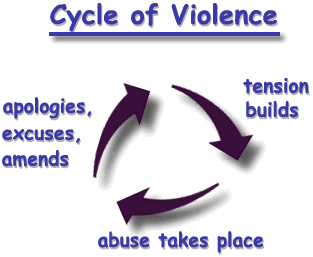
So, children who are living with an abusive parent/abusive parents, who witness their mothers being hit or yelled at or insulted or criticized unnecessarily are more likely to grow up to be abusive or victims of abuse than kids who grow up in a household of one parent. To think that having two parents automatically and necessarily means good children is wrong, incorrect, false, a big fat lie you’re told just so that you continue never experiencing peace, respect, happiness, and/or love in your life.
- Women's support groups
Unfortunately, in all of Pashtunkhwa with very few exceptions, there are almost no women's support groups that you can turn to. However, that doesn't mean they're completely nonexistent. Gather a group of good friends/relatives whom you can trust, especially those who are in your situation, and help each other out. And these support groups don't have to be necessarily counseling services dedicated only to abuse or women who are in miserable marriages. Something like the Roshni Centre (in Swat), founded by someone I know and can trust, is one group where you can turn to for support.
I also understand that, unfortunately, the Pashtun society doesn't think much of things like being actively involved in your community, and volunteering is not a respected activity, so I wish I could suggest that you find something to do around your neighborhood/community to keep yourself busy, such as with teaching poor kids how to read and write. But whatever the case, you definitely need a community, even if it's just to gossip with them, vent with them about everything wrong with the Pashtun society or the world. There's nothing wrong with that if that's going to help you feel better :)
What I’m not saying:
Since I know that I’m often misunderstood, let me clarify a few things.
Since I know that I’m often misunderstood, let me clarify a few things.
- I’m not saying leave your husband and go get a divorce.
- I’m not saying all men are abusive, all men are bad.
- I'm not saying Pashtuns are stupid and backward people (we are not stupid or backward). I focus on Pashtuns here because of the little focus domestic abuse is given. Every single thing I have said here applies to ALL groups of people, not just the Pashtuns.
- I'm not saying all domestic abuse is perpetrated by men and that everything that's wrong in the world is men's fault. Not at all. But I focus on men's abuse of women (wives) because that's more common than the other way around, and I personally don't know of any men abused by their wives.
- I'm not saying all domestic abuse is perpetrated by men and that everything that's wrong in the world is men's fault. Not at all. But I focus on men's abuse of women (wives) because that's more common than the other way around, and I personally don't know of any men abused by their wives.
- I’m not saying be sensitive to everything; in fact, I believe there’s a fine line between being sensitive, letting everything bother or hurt you, and knowing when you are being disrespected, violated, stepped on. Sometimes (but not always), if something that your partner does to you or around you offends you, hurts you, upsets you, insults you, humiliates you—then there’s a problem, and you should know what to do about it if you want to be in a healthier marriage/relationship.
May we all be blessed with happiness, peace, and love all our lives! Aameen.
May we all be blessed with happiness, peace, and love all our lives! Aameen.
Subscribe to:
Posts (Atom)
Related Posts
